
One Diagnostic Problem. Many Clinical Settings
When Static Imaging Misses the Injury
Across personal injury care, regenerative medicine, diagnostic imaging, and med-legal environments, spinal ligament instability is frequently overlooked because conventional imaging evaluates the spine at rest rather than in real-world motion.
Static Imaging Limits
Missed Ligament Injury
Functional Instability
One Diagnostic Standard, Applied Where It Matters Most
Motion-based spinal assessment is used across multiple clinical and diagnostic environments where spinal instability must be identified and documented with confidence. While each setting applies motion-based evaluation differently, the underlying challenge is consistent: static imaging does not capture how the spine actually functions. By objectively measuring spinal motion, providers across these environments gain clearer insight, stronger documentation, and greater control over patient evaluation.
In Practice
How Missed Instability Shows Up Across Industries
Across the industries we serve, providers routinely encounter patients with ongoing symptoms and inconclusive imaging because static studies fail to reveal functional spinal instability.
Subjective to Documented
Findings That Guide Decisions
Why Static Imaging Fails to Tell the Full Story
Anatomical and clinical research shows that spinal ligament injury and altered mechanical behavior are often not visible on static imaging such as MRI and standard X-ray. Instability is a functional problem—one that becomes apparent only when the spine is evaluated during controlled movement rather than at rest.
Motion-based analysis aligns spinal assessment with how patients actually use their spine, providing a more accurate foundation for evaluation, documentation, and review across clinical and diagnostic environments.
- Static imaging evaluates the spine in a stationary, non-loaded position
- Ligament injury may alter motion without visible structural damage
- Controlled motion assessment enables objective measurement of instability
Applied Across Care Settings
How Motion-Based Diagnosis is Used in Practice
Personal Injury Medical Practices
- Identifies motion-based instability
- Documents beyond sprain/strain
- Supports complex case assessment
Spine & Regenerative Medicine Clinics
- Supports evaluation confidence
- Localizes abnormal motion
- Reflects functional spinal movement
Diagnostic Imaging & Med-Legal Providers
- Produces repeatable measurements
- Includes independent radiology review
- Supports external documentation review
Across All Industries
Consistent Diagnostic Outcomes, Regardless of Setting
Objective Diagnostic Clarity
- Quantifies motion-related instability
- Reduces ambiguity from static imaging
- Supports confidence in findings
Improved Clinical Decision-Making
- Informs care consideration
- Supports planning discussions
- Relates findings to symptoms
Stronger Documentation Standards
- Objective measurements with visual data
- Independent radiology review
- Consistent reporting structure
Greater Control of Care Pathways
- Keeps insight in-house
- Reduces external dependence
- Supports care continuity
In Real-World Settings
Designed for Clinical and Diagnostic Environments
Across the industries we serve, motion-based spinal assessment integrates into established workflows in a way that supports evaluation without disrupting routine patient care.
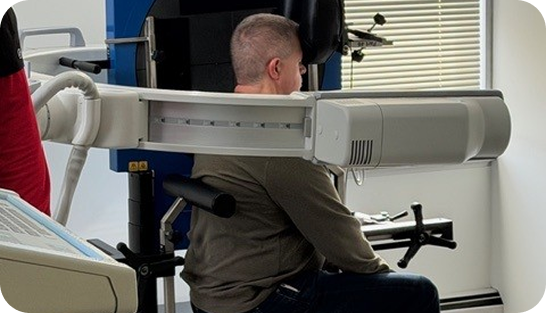
Integrated Into the Clinical Workflow
- Performed in standard clinical settings
- Aligns with patient flow
- Adds minimal operational complexity
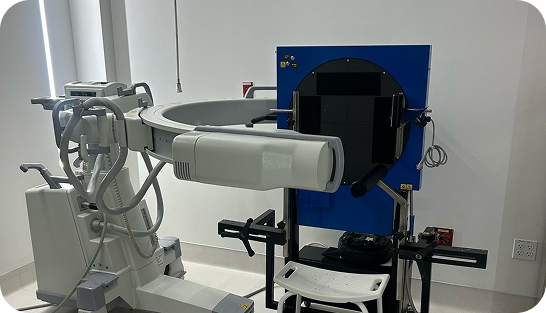
Built for Diagnostic Precision and Review
- Captures controlled spinal motion
- Produces visual and quantitative data
- Designed for high-scrutiny review